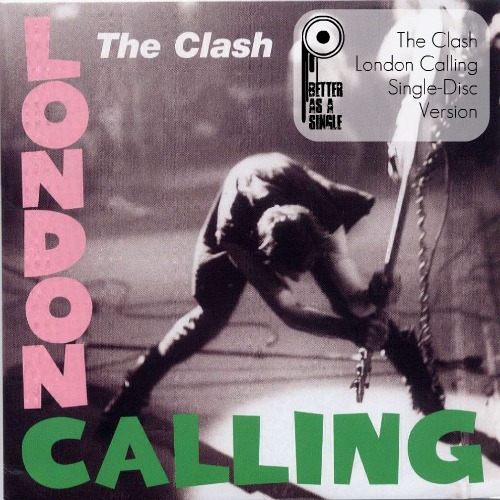
How can you tell when it's all gone to a band's head? When they follow up a successful double-album with a sprawling triple album more than twice its length. When they take the tentative genre departures of the double and turn it into a break-down-the-walls genre mix so extreme they leave no room for the band's original genre itself. When the single album's worth of decent material gets buried so deep amongst sometimes-infuriating offcuts that it manages to get almost completely overlooked.
Sandinista! is a ridiculous, overblown piece of hubris. But it's not worth the scorn that's heaped upon it, really - even if it's got more than its share of tracks which are entirely deserving of scorn. This is a sprawling mess absolutely designed for a project like this, an interactive journey into the Clash's collective mind where you get to play the role of 'editor', since they most obviously won't.
This thirty-six track album was apparently borne out of an idea the Clash had, quashed by the record company, to release a 7" single every month for a year. Which makes twelve, and in fact that math makes sense: twelve serviceable a-sides, twelve decent but less compelling b-sides, and twelve pieces of ephemera designed to be 'bonus track' bait for the twelve-inch. You can almost divide Sandinista! on these lines, and to a certain degree, with a bit of juggling, you'll find that disc one contains the would-be singles, disc two the serviceable b-sides and disc three the weirder 'filler' (note that the actual choice of singles from this project was highly suspect, to the point that of the three singles pulled from this album, I've taken only one onto my single-disc version, binning the other two).
Still, that doesn't mean disc one is the best and disc three the worst. The three discs aren't that different from one another, though the third one contains the lion's share of the 'dub versions' that are scattered throughout this disc and largely (and undeservedly) give it its reputation as 'bloated with filler'.
There is an unpleasantly dilettante-like feel to the way the Clash seem keen on trying out every genre out there, from calypso to gospel, from rap to rockabilly, from jazz to disco. From brass bands to marimbas, pinball sound effects to backwards-tape sound collages. They take on these varied genres with a rather unfortunate lack of sincerity, and spend so much time 'experimenting' that they pretty much entirely look over the genre of punk, the genre that birthed them and with which they remain most closely identified. The one significant exception, though, was reggae - a music that by 1980 the Clash had become so good at that it had really overtaken punk as 'the thing they do best'. The reggae tracks here, and the dub versions as well, are nothing like the half-hearted 'touristic' genre excursions we see elsewhere on these discs: they're the 'real thing', as deeply felt as anything the Clash ever did. And they're also largely the highlights of these three discs, so much so that my single-length is almost 50% Jamaican-influenced music. I only take one of the dub versions, but none of them are outright failures or even unpleasant to listen to.
That accolade is reserved for the absolute nadir of the Clash's recorded career (with Mick Jones), also to be found here: the Clash's desire to expand their palettes and move beyond the conservative impulses of their fanbase is admirable. But when it comes to such contemptuous moves as playing a song backwards and calling it a different piece altogether, or bringing in a few kids to re-record some of their punk-era classics... such nose-thumbing moves would have destroyed lesser bands and did much to undo the populist notion of foregoing royalties in order to keep the price of the bloated project down.
So all told, it's completely ridiculous that Sandinista! has thirty-six tracks and lasts 144 minutes. The Clash had all but lost the sense of concision and cohesion that had made them such an arresting and era-defining act just a few years ago, and amazingly, after a double and a triple, Combat Rock would also have been a double had the label and management (and half the band itself) revolted against the unwavering tendency toward excess. And yet while there's no dissent that Sandinista! could have used some slimming down, there's no agreement at all on where those cuts would be made: the record label put out a 12-track promo disc called Sandinista Now! that attempted to showcase the highlights, and yet merely seven in twelve songs overlap with the contents of my single-disc.
Don't worry: they were out-of-touch corporate suits. Mine is better...
Sandinista!
Side one
Side one
- The Magnificent Seven (5:28)
- Junco Partner (4:53)
- Washington Bullets (3:51)
- Kingston Advice (2:36)
- Somebody Got Murdered (3:34)
- One More Time (3:32)
Side two
- Police on my Back (3:15)
- Up in Heaven (Not Only Here) (4:31)
- Corner Soul (2:43)
- Charlie Don't Surf (4:55)
- Rebel Waltz (3:25)
- Version Pardner (5:22)
The album's opening track and best-known single is, of all things, a rap tune. This predates even Blondie's 'Rapture' as an appropriation of rap by a white rock act, though that as a stat means next to nothing all these decades later. In fact, you don't really even notice that it's rap if it's not called to your attention; Strummer's flow is such that it feels more like a pop song with a rather monotonous melody. But the rhythm section somehow manage to be amazing while aping the Sugarhill Gang aping Chic. And Joe Strummer's lyrics, political at a time when that was all but unheard of in rap, are alternately excellent and ridiculous. Strummer is definitely the highlight of this song, though, going on and on and on about everyman's everyday life, and whatever else pops into his head. It's all a bit silly, and yet somehow it's wonderful too. How's that work?
An arresting opening track on the triple, it remains so on my reduced single-length. Though it certainly doesn't exactly sound reassuring to people wondering if this punk band has betrayed its roots.
Hitsville U.K.: lose
If you have a thirty-six track album, do you still front-load side one with singles? Evidently so: second track, second single. This one, however, is entirely unworthy: a decent attempt at a kind of Supremes-like Motown rhythm track is smothered under a grating singsong-y melody sing by Ellen Foley, better known as the girl in Meat Loaf's 'Paradise by the Dashboard Light'. Apparently the lyrics are in defence of independent record labels (by a band signed to CBS), but it's tough to imagine this ditty would have much street cred. Except on Sesame Street, I suppose.
Junco Partner: keep (side one, track two)
Sandinista! is a ridiculously eclectic album, and while many of the experiments miss the mark, there are occasions here where it comes off brilliantly. What are the odds of an ancient jump blues tune being resurrected with a reggae beat and a squeaky busker's fiddle being anything but hideous? And yet the result is completely wonderful, and I'm not even sure how. It's got a lot to do with Joe Strummer again, singing with a ridiculous accent but with a world of heart, genuinely excited about their new role as meeting point of diverse global folk music traditions. Can't see the mohawk-and-safety-pin crew digging it, but it's great stuff.
I had a notion that I should put together my twelve-track twelve-inch by alternating 'rock-influenced' tracks with 'reggae-influenced' ones. That didn't quite happen, but you will find that reggae tracks have even track numbers on my project. The triple gives a prominent spot to 'Junco Partner', and I do even more so, moving it forward one place to spot two on side one.
Ivan Meets G.I. Joe: lose
This is, wait for it, a disco tune played by ex-punks featuring video-game noises and Cold War lyrics. Digest that for a minute: is that not the single most dated description of a piece of music ever? Even if you weren't born in 1980, this song will transport you right there. But not in any desirable way, as the song seems calculatedly designed to make Topper Headon's sole lead-vocal turn seem comparatively less annoying.
The Leader: lose
A brief little throb of a tune, more rock and roll than punk. It speaks about corruption in politics, or something like that, but really the verses are relevant only in that they lead into, and build up to, the single-line refrain which serves as the song's only real focus. Quite inessential.
Something About England: lose
An ambitious track, with a brass band, piano, a fiddle, 'It's a Long Way to Tipperary', and all kind of little parts to it (like a suite of less than four minutes or something). The lyrics seem to be saying something about England down the years... but the sad fact is that the whole end result is merely too messy to pay all that much attention to.
Rebel Waltz: keep (side two, track five)
This track regularly gets overlooked when people discuss Sandinista!, and I wish I knew why; I see it as a quite elegant and evocative little experiment: it actually is a waltz, with an inessential baroque harmonium less important than a resonant line played on guitar, most prominent in the extended introduction before the beat kicks in. Sandinista! has more genre experiments than you can shake a stick at, but this is perhaps the least self-conscious of all of them. And it's really quite beautiful in its vaguely European way.
Finding the right home for this track was a tricky thing. In the end I put it as track five on side two, next-to-last. Or, considering what my closing track is, you could consider that one a 'coda' and this one the actual conclusion.
Look Here: lose
A cover. But really 'Jimmy Jazz' played much faster, and just as unpleasantly hackneyed. The fact that the Clash could play several genres expertly doesn't quite mean they could pull every one off.
The Crooked Beat: lose
I've heard this called a 'Guns of Brixton' clone, but I don't hear it. What it has in common is an asymmetrical reggae pulse and the two lead instruments (vocals and bass) being performed by Paul Simonon. But this is just a bit too 'crooked' for its own good, drums reduced to mere echoed noises like a ruler on a school desk and the song deconstructed to the point that it's almost impossible to pick out. There are some interesting ideas here, beneath Simonon's flat monotone, but not enough, I'm afraid.
Somebody Got Murdered: keep (side one, track five)
Apparently, this track was intended for use in a movie but was left on the shelf: that's appropriate, because there's a decidedly widescreen cinematic feel to this track, not only in the hushed lyrics observing the death of an anonymous stranger but also in the lush guitar-saturated musical accompaniment, a deliberate chord progression that closely follows the melody, enhancing the slightly dazed feeling of regret. All told, it's a beautiful piece, professional but still heartfelt.
My side one is comprised largely of songs from the first of the three records on Sandinista!, which is perhaps not that surprising. Track five on side one might seem tantamount to 'burying' this exquisite song, but it fits the flow quite well.
One More Time: keep (side one, track six)
While the Clash had been messing around with reggae styling since their début, it`s amazing by now the extent to which they've assimilated the sound. This is not `reggae-punk`or anything of the kind, it`s merely an expertly played self-written reggae song. It`s really an impressive piece of work, with a memorable chorus and with some amazing bass playing. There is echo, but not so much. It enhances, not distracts. Not yet, anyway.
This follows straight out of 'Somebody Got Murdered' on the triple, so I thought I should preserve that pairing on my single-length. So as that track is number five, this is number six on side one, the side-closer.
One More Dub: lose
Dub is no small part of this album, with quite a few 'dub versions' of otherwise existing tracks, mostly to be found on side six. Now, I like dub. Quite a bit, actually. But it rarely sits well alongside other kinds of music: it's consumed differently, in a different state of mind and to a different end. This here is the only occasion on Sandinista! when the original and the dub are put back to back, and the effect is essentially to create a seven-minute extended remix. I would consider this one of the best dub versions on the album, and quite worthy in its own way of release. The main reason I choose to overlook it is because I feel that one 'dub version' is the right number for my single-disc edit, and there just so happens to be a dub version that I prefer to this one.
Lightning Strikes (Not Once but Twice): lose
Side three starts with the sound of a radio DJ, something that crops up quite a few times on this side. It goes from there into the album's second and final rap excursion: a less Sugarhill-influenced musical backdrop over which Strummer spits and slurs in precisely the same flow as 'The Magnificent Seven' - seriously, listening to the two back to back is like listening to a 12" extended mix of a single song. Diminishing returns, though (despite the song title), perhaps because what he has to say isn't overly interesting.
Up in Heaven (Not Only Here): keep (side two, track two)
How exactly did the Clash go from punk clubs to open-air stadiums, in just a few scant years? Well, songs like this provide some kind of an answer: this is not punk at all. It's music designed to play on 'rock radio', but what makes it fail to be a sell-out concession is its uplifting feel; this is somehow a truly glorious song, something that makes you feel better about your lot in life, and while it's probably just as artificial a feel-good sensation as anything any 'classic rock' band ever perpetrated, somehow with the Clash you want to believe it's sincere. Plus you get weirdness at the end, whether or not you asked for it.
My original impulse to alternate rock tunes with reggae tunes fell apart when considering the first half of side two. I just couldn't get over the sense that side two needed to start with a one-two punch of 'rock' music. Now, this is not especially abrasive, but it is rock. I tried making it track three, but it didn't work. So damn arbitrary logic; here's my side two, track two.
Corner Soul: keep (side two, track three)
Why do I like this tune? I'm not really sure: it's understated, and to a certain extent fades into the background unnoticed, despite strangely violent lyrics and an accordion. It's probably that great chorus with its whooping background vocals. That must be it. Or maybe it's its lowered reach; rare on these discs, this is no type of experiment or showboating but merely the Clash delivering truly melodic and memorable music. Just to prove they can, if they so choose.
I'm pretty sure I didn't realise, when putting this in the doldrums of side two, track three, that I pulled off another two-song-set replicated from the triple, just like 'Somebody Got Murdered' leading into 'One More Time'.
Let's Go Crazy: lose
Reggae was a rock-influenced genre anyway, so the Clash and other white musicians found themselves able with varying levels of success to 'accommodate' the genre. However, reggae is merely one of many Caribbean genres, each of which would have been quite prominent in the yearly Carnival festivities in London that the Clash seem to have genuinely enjoyed attending. And seeing as how Sandinista! features the Clash tackling as many as a dozen different genres, it's perhaps not surprising that they would attempt a Carnival-style mix of Caribbean music. But it's dilettantism as this point, as they may well like calypso and other forms of Caribbean music, but they don't feel it.
If Music Could Talk: lose
The trick here is that Joe Strummer recorded two entirely different lead vocals for this track, hard-panning them so that one appears in the left speaker only and the other in the right. A studio trick that at best constitutes a 'good idea', but it's in service of an unpleasantly slick saxophone-led musical backdrop, and the whole thing is profoundly uninteresting.
The Sound of Sinners: lose
Since they take on so many genres here, it ought not to surprise us that the Clash also take a stab at American gospel music here. The thing that's bizarre is that they almost pull it off. But where you rarely question their sincerity on the other genre experiments on Sandinista!, on this particular track you can't avoid the feeling that the whole thing is merely a tongue-in-cheek send-up (particularly once Tim Curry comes in at the end playing an avaricious preacher). Then the question is, 'why?' The track is not a parody, and it's not funny - it's enjoyable merely because it's a competent take on a sometimes-enjoyable genre. But do the Clash themselves enjoy it? And if they don't, why record it?
Police on My Back: keep (side two, track one)
Though it's a cover of a late-sixties stomper written by, of all people, Eddy Grant, this track is noteworthy for being, on this incredibly eclectic genre-hopping album, the sole track on the whole project that could be considered 'punk', i.e. performed in the genre that brought the Clash to fame. And it really has to be mentioned that they really are adept at this sort of thing. It's a full-group shout-along as they rush through a listing of the days of the week (he has to do a lot of running from the police), half-buried beneath delightfully crunchy guitars. It's merely 'side four' on the vinyl, but it's the halfway point, start of the second CD and time for a rush of new energy. And damn does it feel good.
The halfway point is exactly where this song needs to be, so that's where I put it: side two, track one.
Midnight Log: lose
130 seconds of echoed rockabilly with a barroom piano and a kind of melodica sound: attractive, but not overly memorable. God knows what Strummer is talking about in his Presley swagger.
The Equaliser: lose
Another reggae-ish track trumped up with violin. And with odd sound effects and with loads of echo as well. This is the dub version version of what might be a pretty decent tune. As much as I like dub and studio manipulation, though, I can't help finding this almost-six minute tune self-indulgent and not very enjoyable. What would it have sounded like if it were more disciplined, I wonder.
The Call Up: lose
God knows why exactly, but this was the first single released from Sandinista!, the 'teaser' for the album. And shy of 'Mensforth Hill', it's tough to imagine a less appropriate track. It's not that bad, but it's an oddly glitzy five-and-a-half minute studio concoction of no recognisable genre that harangues in a repetitive melody about enlisting in the USA army. Considering it's the only single on the second through sixth sides of this album, it's doubly peculiar. And it goes on way too long.
Washington Bullets: keep (side one, track three)
Though never a single, this might well be the album's most celebrated track: an astutely written take on international politics and American interventionism with some criticism of Moscow and Beijing added to provide balance. It's quite impressive, and definitely an album highlight (in addition to being the title track). However, sonically it's more than a little gauche, with a rather overly prominent marimba line serving as the main instrument. It's quite 'adult' music, 'sophisticated' and more than a little bloodless. And, though it's redundant to point it out, not very punk at all. Plus, after the 2:45 point, it becomes progressively more annoying. This doesn't really sound like I like the tune, does it? I do, though.
This is track three on side one on my twelve-track, a sudden rise to prominence for a song buried deep on the triple. But it is a central part of the disc, and pushing it up to the front gives the album a more prominently political feel than the sprawling triple has. And after all, it is named Sandinista!
Broadway: lose
This atmospheric tune builds up slowly across the minutes, creating an interesting if not overly noteworthy mood before falling into dissonance. This tune was noteworthy enough to give its name to the Clash's career-overview boxed set, for some reason. Incidentally, the song itself is only 4:53. The remainder is given over, not for the last time on this album I fear, to one of the keyboard player's kids singing an old Clash. Aww, cute, said no-one.
Lose This Skin: lose
This track is written by an old 1960s leftover named Tymon Dogg, who also sings it in a highly peculiar and much-derided voice. His violin is also the primary instrument. This song gets a lot of bad press, but I think it's quite an attractive composition, and the voice? Well, you can get used to it. Hell, we got used to Axl Rose, right? My beef with the song is not its quality so much as the fact that it's not properly a Clash song but entirely a Tymon Dogg song with backing by the Clash. And what's the point of that?
Charlie Don't Surf: keep (side two, track four)
This poor tune is stuck in a particularly weird part of the album, and I think it fails to get its due props because of that. It is in fact an atmospheric reggae-like take on American involvement in Vietnam. It's kind of a dry run for 'Straight to Hell', which is a better song. But it's no slight on this track to say it's merely not as good as one of the Clash's very best songs. It has a hazy atmosphere courtesy of a kind of phased sitar-sound. The track is much more down-to-earth than that description, though - at least till the end, as the song slowly disappears into a studio-created haze. Fascinating, and overlooked.
There is a bit of a reggae pulse to this song, but it doesn't feel reggae. Still, I give in an even-numbered placement as track four on side two. The fact that the song both starts and ends with 'atmosphere' meant it needed, really, to follow a song with a cold close and precede a song with a cold opening. Well, I tried.
Mensforth Hill: lose
This is apparently 'Something About England' played in reverse, with all kinds of random voices and sound effects thrown over top, what might charitably be called a 'sound collage'. What most reviewers and Clash fans down the years have called it is less printable. And they're completely right: it's an inexcusable load of nonsense.
Junkie Slip: lose
Another 'rebel music', the Clash were able to accommodate their love of reggae in an unashamed fashion. Their skiffle/rockabilly fantasies, however, always had to be snuck in in a semi-ironic way, for fear, I guess, of seeming musically conservative. It's a pity, because the genre does lend itself to creative variations, as we hear at the moment. This is a messy but quite interesting mess of popping basslines and vocal hiccoughs. Cute, if not revelatory.
Kingston Advice: keep (side one, track four)
This song starts out with a barrage of special-effects vocal treatments, and by this part of the album we might well have found ourselves bored of studio trickery. Yet here's the weird thing: this song bursts to such exciting life when the chorus arrives that suddenly whatever intentional weirdness they stick over top seems less of a hapless attempt to make a generic track distinctive than an obvious addition to an already excellent track. Buried and unloved, this is still a great track.
I put this overlooked track on side one, track four. And I won't pretend that it was irrelevant that this resulted in having a song called 'Kingston something' follow a song called 'Washington something'. Makes you expect this one to be a kind of part-two.
The Street Parade: lose
Bursts of what sounds like a steel drum link this song to the would-be calypso 'Let's Go Crazy', but where that track is a failed take on a particular genre, it's tough to say exactly what this even is, being a messy mix of varying sounds seemingly being played at different tempi over top of each other. It doesn't come close to coherent, and by the end you'll just be left scratching your head, if you can even be bothered to wonder.
Version City: lose
"Version City": While three of the six songs on side six, the 'dub side', are indeed versions of songs appearing elsewhere on Sandinista!, this particular track isn't. It's actually a propulsive semi-reggae tune with an unexpected but welcome harmonica. It has a pleasantly sloppy quality that unfortunately lapses entirely into messiness at certain parts, not least of which the rather bizarre introduction that kind of spoils the effect.
Living in Fame: lose
Producer Mikey Dread toasts on this, a 'dub' version (so to speak) of 'If Music Could Talk' that has an enjoyable though not overly dubwise propulsive quality to it. Dread isn't very easy to hear and it turns out to be easier to tune him out than to listen to him. A valiant effort and quite listenable indeed, but not one of side six's high points.
Silicone on Sapphire: lose
I'd call this a dub version on 'Washington Bullets', but it really isn't - if anything, it's an instrumental version of that song with a mess of sound effects and random voices stuck over top. And since the instrumental backing track is what I like least about 'Washington Bullets', I can't find much to recommend this particular piece of fluff.
Version Pardner: keep (side two, track six)
"Version Pardner": Here it is, the only dub version on Sandinista! to make my final cut. So let's talk about why: well, first of all, I love the original and it's genre-blending assurance. This dub version preserves a lot of the original but takes it a good deal further, being essentially a journey through different moods, a little noise here, an off-key melody there. It's strange stuff, messy like this whole disc is, but somehow wonderful.
And the only dub version I choose gets put in the most logical position on the album: the final track, number twelve. Why? Well, I think it belongs, but I admit it's a bit, well, 'supplementary'. In a sense, it's like the album closes with 'Rebel Waltz' and then this is a bit of a 'bonus track'. For an album that just doesn't know when to quit. And isn't Sandinista! quite obviously that very album?
Career Opportunities: lose
Probably more hated than 'Mensforth Hill', yes this is indeed an early Clash hit remade as a jokey little ditty sung by two kids, sons of the keyboard player. Seemingly, the Clash hate where they came from enough to belittle a great early tune of theirs as cheesy family fare - realistically, this is probably meant to be a situationist send-up like the disco covers on Malcolm McLaren's Great Rock 'n Roll Swindle soundtrack. But there's no reason on God's green earth you'd want to listen to that either.
Shepherds Delight: lose
Really, was it ever in doubt that they'd end the album on a WTF moment? I don't think anyone would have suspected acoustic instruments and barnyard noises, but who could underestimate the Clash's willful contrariness by now?